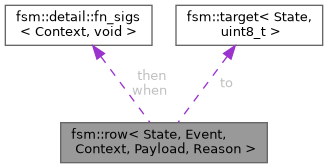
One transition-table row: {from, on, when, then, to}. More...
#include <fsm.hpp>
Public Types | |
| using | payload_type = Payload |
| using | reason_type = Reason |
| using | guard_fn = typename detail::fn_sigs< Context, Payload >::guard |
| using | action_fn = typename detail::fn_sigs< Context, Payload >::action |
Public Attributes | |
| from_spec< State > | from |
| Source state or fsm::any (mandatory). | |
| on_spec< Event > | on |
| Trigger event (mandatory). | |
| guard_fn | when = nullptr |
| Optional guard. | |
| action_fn | then = nullptr |
| Optional action. | |
| target< State, Reason > | to |
| Transition/internal/refuse (mandatory). | |
| const char * | label = nullptr |
Detailed Description
struct fsm::row< State, Event, Context, Payload, Reason >
One transition-table row: {from, on, when, then, to}.
Rows are plain constexpr data: enumerable, dumpable, diagrammable. Matching walks the active state chain leaf → ancestors → fsm::any rows; within a level, table order, first row whose guard passes wins.
- Template Parameters
-
State state enum (dense, Countsentinel)Event event enum (dense, Countsentinel)Context user context passed to guards/actions by reference Payload optional event payload type (void = none) Reason refusal reason type
Member Typedef Documentation
◆ action_fn
| using fsm::row< State, Event, Context, Payload, Reason >::action_fn = typename detail::fn_sigs<Context, Payload>::action |
Transition/internal action. nullptr = none.
◆ guard_fn
| using fsm::row< State, Event, Context, Payload, Reason >::guard_fn = typename detail::fn_sigs<Context, Payload>::guard |
Guard: arbitrary predicate over context (+ payload). nullptr = always pass.
◆ payload_type
| using fsm::row< State, Event, Context, Payload, Reason >::payload_type = Payload |
◆ reason_type
| using fsm::row< State, Event, Context, Payload, Reason >::reason_type = Reason |
Member Data Documentation
◆ from
| from_spec<State> fsm::row< State, Event, Context, Payload, Reason >::from |
Source state or fsm::any (mandatory).
◆ label
| const char* fsm::row< State, Event, Context, Payload, Reason >::label = nullptr |
Optional human-readable note ("why this row exists"), shown by dump() and fsm::write_dot(). Guards/actions are bare function pointers, so this is the only place introspection can find intent.
◆ on
| on_spec<Event> fsm::row< State, Event, Context, Payload, Reason >::on |
Trigger event (mandatory).
◆ then
| action_fn fsm::row< State, Event, Context, Payload, Reason >::then = nullptr |
Optional action.
◆ to
| target<State, Reason> fsm::row< State, Event, Context, Payload, Reason >::to |
Transition/internal/refuse (mandatory).
◆ when
| guard_fn fsm::row< State, Event, Context, Payload, Reason >::when = nullptr |
Optional guard.
The documentation for this struct was generated from the following file:
- include/fsm/fsm.hpp